Built for Six Percent
Welcome back to Marginal Matters, the free series where we take one piece of research, sit with it, and walk it through our own data until it makes sense.
Something new: The Morning Monitor.
Every morning before the open we sit down with the same thing, a short note and a full deck of charts pulled from our own database and run through the same twelve-pillar framework behind everything we publish. It's how we start the day, and it's the read we lean on when we're deciding what actually matters. Until now it went to exactly one inbox, ours. Starting today it's open to anyone who wants the charts, and the framework behind how we think, every morning.
What's in it: that morning note and its charts, emailed to you and on the Monitor board in Pharos, plus the deck as a PDF if you'd rather flip than scroll. You also get the twelve Diagnostic Dozen boards in Pharos, each pillar on its own board, and the tear sheets that explain how we read each one. The written research and the rest of the terminal stay with the full membership.
Two mornings are open so you can see exactly what it is before you pay: Oct 23 and Oct 27.
The Morning Monitor, $200 a year.
Or $20 a month. https://pay.lighthousemacro.com/b/5kQdRa5Pb2gE2Dga0xabK02
The first ten annual sign-ups take 25% off the first year with the code FIRSTTEN at checkout.
The Watch, the full membership (research plus Pharos), is unchanged at $500 a year or $50 a month and includes everything above.
This week we're going back to the trade in the middle of the chain, the one we gave a single paragraph at the end of The Second Round, to find out why it stopped growing.
Where the Regulars Went
When a bar that has been three deep for years is suddenly easy to get a drink at, the neighborhood has theories. Too many copycats opened on the block. The place across the street started pouring the same thing cheaper. Almost nobody asks whether the regulars found somewhere they'd rather be, which is usually the answer.
The Treasury basis trade has been the busiest bar in the market for five years. Hedge funds buy Treasury bonds, sell Treasury futures against them and finance the bonds overnight in repo, and because the gap between the two prices is a sliver of a percent they use enormous leverage. It peaked in November 2024, spent 2025 on a plateau within sight of that peak, and this year it quietly started to shrink. No panic, no Fed. The theories were the neighborhood's: the trade got crowded, or a loosened bank capital rule let dealers take the business from the funds.
Matthew McCormick, Srini Ramaswamy and Hugo De Vere at the Dallas Fed published a piece on October 16 called "Contract design, higher yields make basis trade alternatives attractive," and their argument, boiled down, is that the regulars left. "We argue that the trade has become less rewarding for asset managers," they write, with three lines of evidence, and a fourth possibility they are careful to call anecdotal. The asset managers on the long side of the futures got less out of owning them, for a reason built into the contract. Hedge funds' returns show no sign of crowding. They also found a trade next door that pays about as well per unit of risk. And asset managers may be getting their duration from swaps written to finance data centers.
We took it to our own data, and the part that held best sounds most like a line in the contract's fine print.
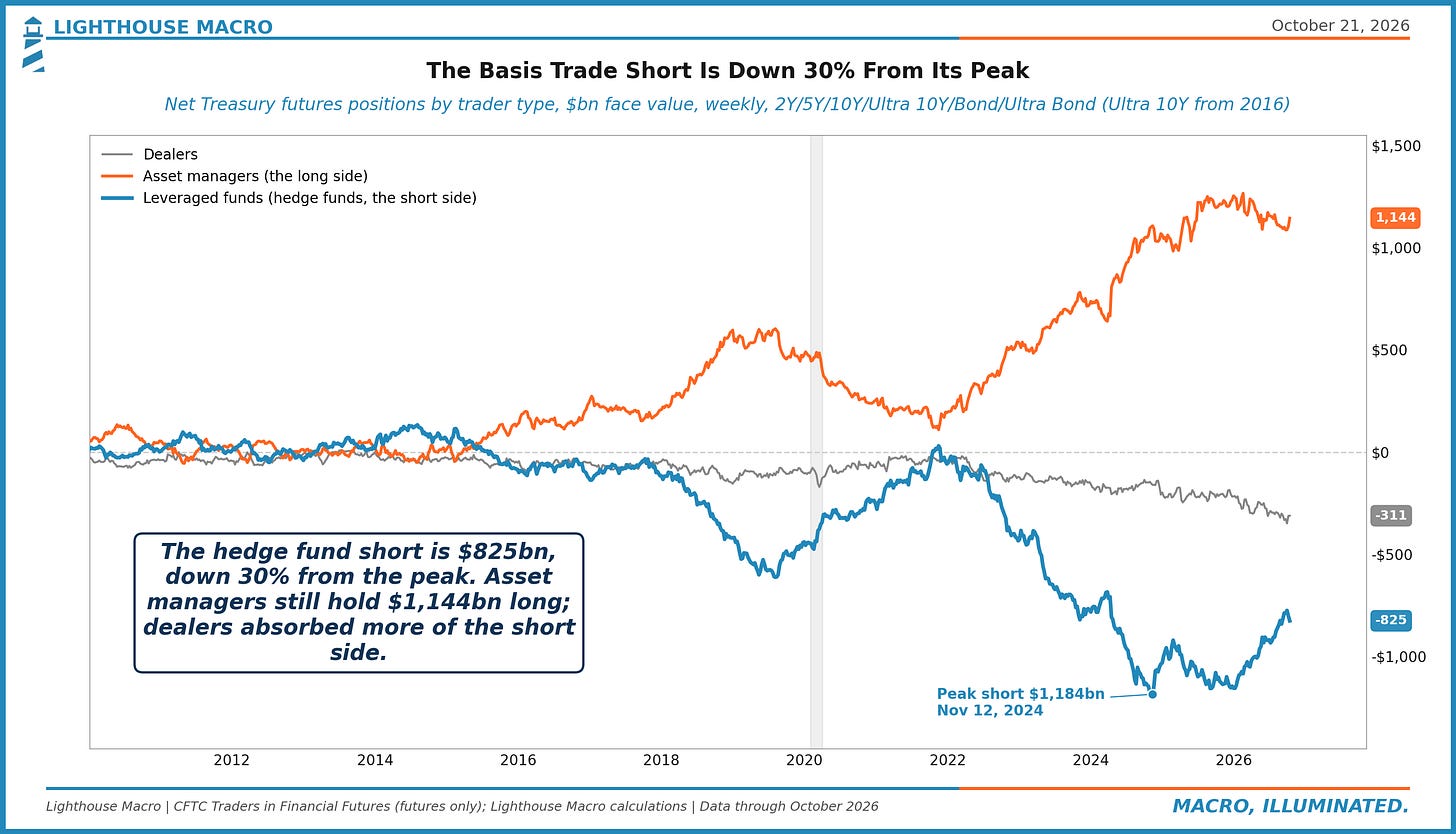
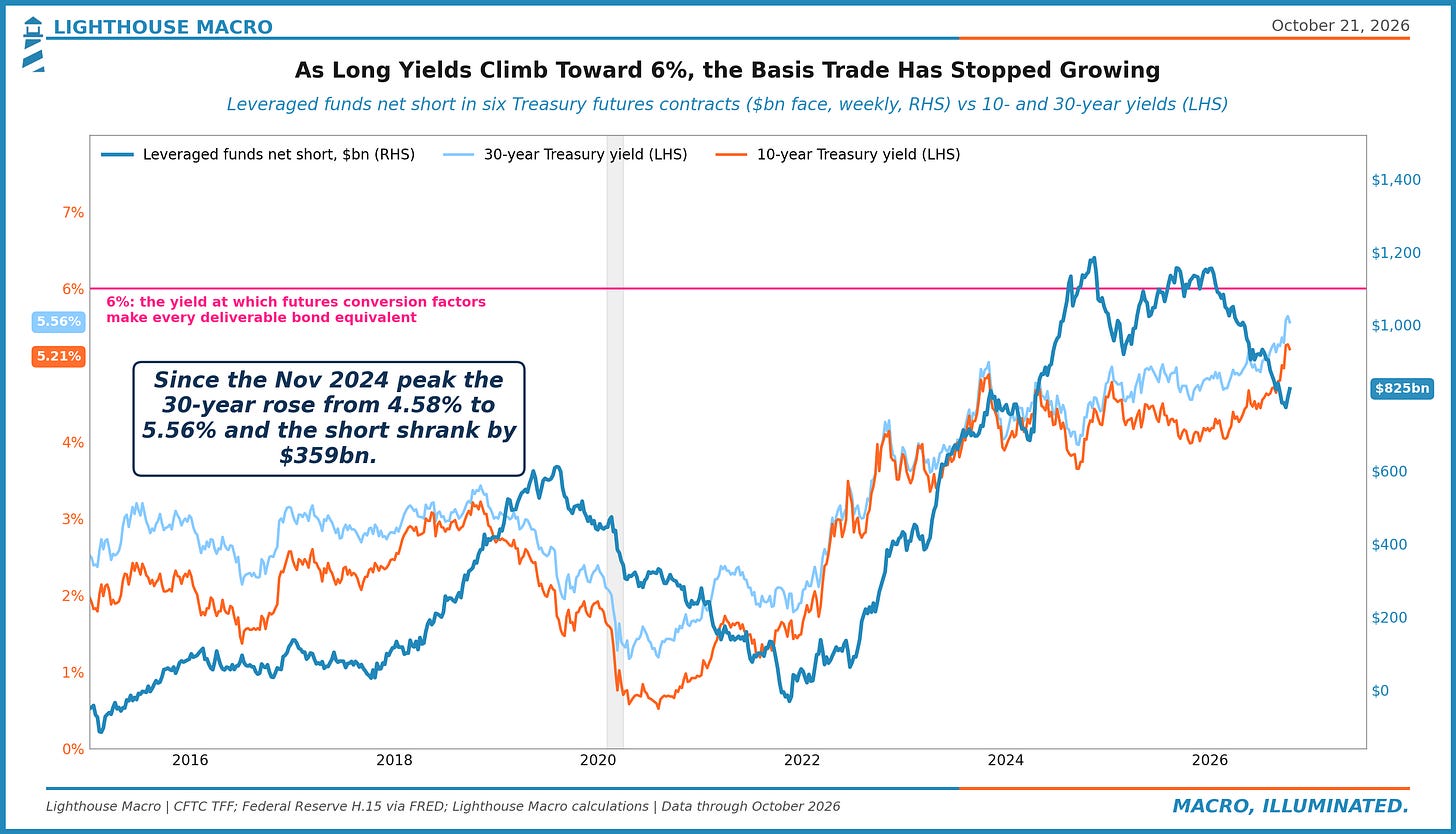
In the Commodity Futures Trading Commission's positioning data, measured in face value this time, not the 10-year equivalents we used last week, leveraged funds' net short across six Treasury futures contracts peaked at $1,184bn on November 12, 2024. The latest report has it at $825bn, down 30%, with asset managers $1,144bn long on the other side. Dealers' short roughly doubled, to $311bn on October 13, which answers some of who sells and none of why the buyers stopped.
A Price Card Printed at Six Percent
Picture a shop that takes any of a dozen currencies, at rates printed on a laminated card taped to the register years ago. If today's rates match the card, it makes no difference which currency you hand over, and the right to choose is worth nothing. The further the market drifts from the card, the more one currency becomes the obviously cheap way to pay. Now the right to choose is worth something, and how much depends on the drift.
Treasury futures are that shop. A contract can be settled with any of several eligible bonds, and the party short the futures, the hedge fund, decides which. Because the bonds carry different coupons, the exchange scales each with a conversion factor, and here is the design choice the paper turns on: the factor is what each bond would be worth if every bond yielded exactly 6%. That is the laminated card. "That fixed 6 percent is just a design choice," the authors write, "but is crucial in explaining recent trends."
"When the market yield is exactly 6 percent, every bond's scaled price equals one, regardless of coupon." Market matches card, and the choice is worthless. The further yields sit from 6%, the more one bond stands out as cheapest to deliver, and the more the right to pick it is worth. For a generation that right was worth plenty, because yields sat nowhere near the card.
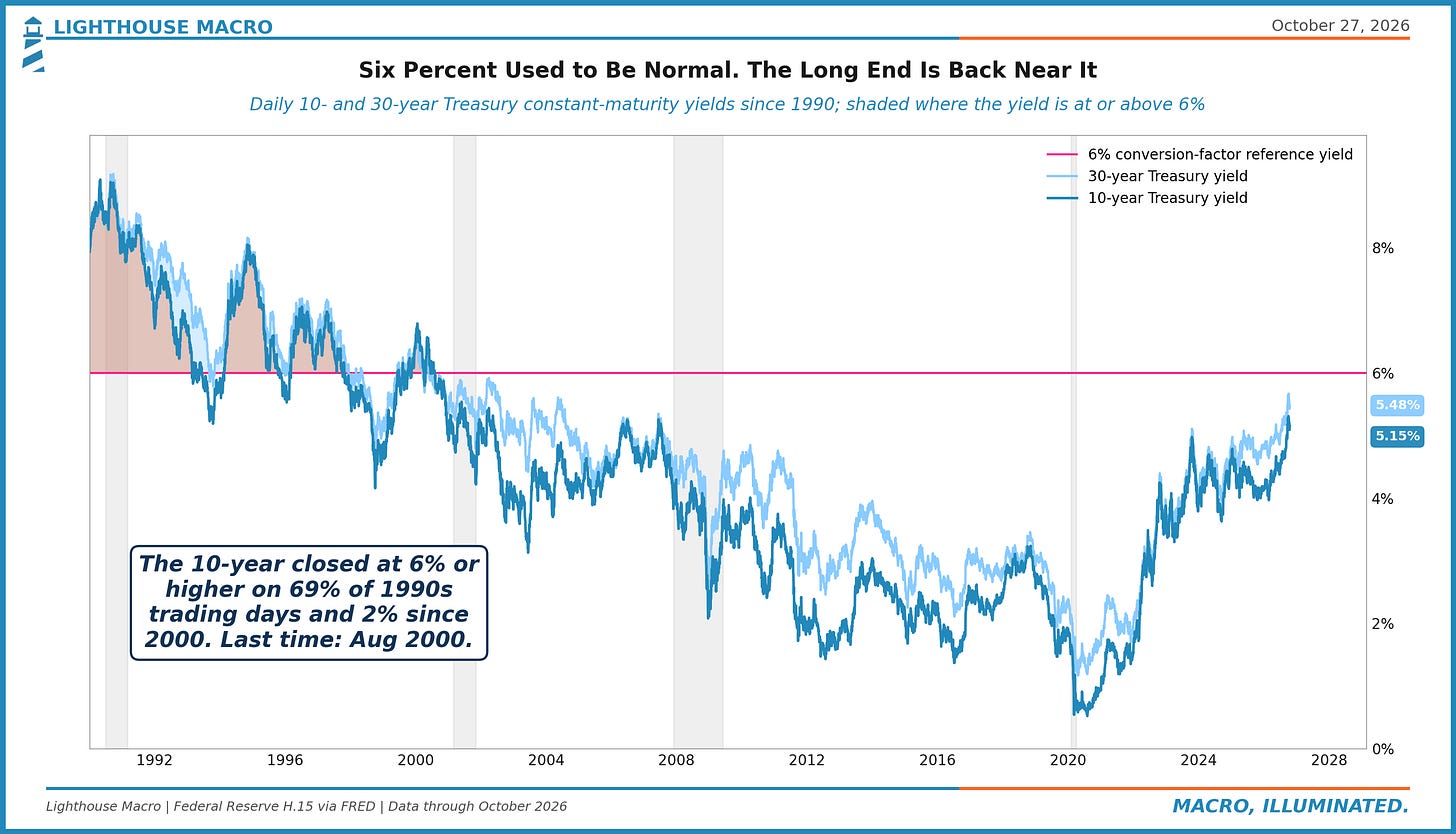
In the 1990s the 10-year closed at or above the card on 69% of trading days and the 30-year on 84%. Since 2000, 2.0% and 1.1%. Anyone who started on a desk after the dot-com bust has never worked a day above the card, and that includes us. Then the 30-year reached 5.67% on October 7, its highest in more than two decades.
What the Right to Choose Is Worth
Strip the carry out of the basis and what's left is the basis net of carry, BNOC in the paper, which "is best understood as an option premium." A hedge fund that buys the basis owns that option, and pays for it: if no switch comes before delivery, the premium bleeds to zero. An asset manager that owns futures has sold it, and gets paid by the futures trading a little cheap relative to the bonds. Far from 6%, with the cheapest bond entrenched and switches rare, that was like selling flood insurance in the desert.
Hedge funds don't want an option that bleeds, so they buy it cheaply in the basis, sell a replica in the rates options market for more, and keep the gap. That gap is the authors' second piece of evidence: it has held steady or narrowed, where a crowded trade would show the opposite.
With the long end within a point of 6%, the deliverable bonds already look alike, so modest yield moves either way can flip which one is cheapest. The option has moved close to at-the-money, and selling at-the-money options is a coin-flip business. Falling rate volatility from August 2025 to August 2026 shrank the premium further; the jump since September doesn't change that, and the authors think it may not be enough to pull asset managers back. Futures got less cheap. The regulars drifted.
An aside and a footnote are worth the price of admission, which is still zero.
The aside explains the headline number. The 2-year and 5-year contracts have so little duration that yields would have to sit much farther from 6% for their deliverable bonds to look different, so their delivery option is always nearly worthless. That matters because, of the $359bn that came off the short since November 2024, $265bn is the 2-year. In face value the trade is down 30%, and that number is mostly the 2-year. The authors add that on a duration-weighted basis "much of the decline in the basis trade's footprint has occurred in longer maturity sectors," which our peak-to-now face-value split doesn't show, because the long-contract shorts rebuilt through 2025 before coming in this year. The window you pick decides the story.
The footnote is number 7. Treasury futures stop trading before the cash market closes, so the short gets a daily window to watch bonds move with the futures price fixed and decide whether to deliver. That window, the wildcard option, has historically been a primary driver of the Ultra Bond's basis, and its value lives in the gap between a bond's conversion factor and one. As the very low-coupon bonds sold during the pandemic roll out of the deliverable basket, that gap closes and the wildcard fades. A trade is losing value today because of bonds issued in 2020 and 2021. We find that delightful, which probably says something about us.
Same Risk, Smaller Cup
A hedge fund allocates on return per unit of risk, so what moves capital is whether a trade beats the next-best use, and the next-best use got a lot better. The close cousin is the swap-spread widener: buy a Treasury, and instead of selling a future against it, pay fixed in an interest rate swap, which makes money when swap rates rise relative to Treasury yields. "Front-end swap-spread wideners have become markedly more attractive recently," the authors write, with carry per unit of risk now close to what they estimate for a long basis in the classic bond contract, where they assume a skilled trader clears roughly 6.25bps a quarter before scaling for risk.
A swap-spread position carries far more dollar risk per dollar of notional than a basis position. Espresso and drip: the same caffeine in a fraction of the cup. Move a modest slice of a risk budget from basis to swap spreads and you carry the same risk in much smaller positions, so the futures, the cash Treasuries bought against them and the repo that financed them all shrink together, out of proportion to the capital that moved. The basis can still be making money while this happens, so long as it makes slightly less than the trade next door.
If asset managers are buying fewer futures, where is the duration coming from? The authors don't see a move into cash bonds, so their candidate is swaps. Financing a data center means borrowing long and fixed, and a borrower that can't place all of it in the bond market can pay fixed in a swap to stretch the duration, while one whose private credit loan floats pays fixed to lock it. Life insurers are the natural receivers, and receiving fixed is buying duration without touching a futures contract. The authors are straight about the evidence: "Quantifying the extent of such flows is difficult, as much readily available evidence is anecdotal." A hypothesis, until somebody measures it.
How to Read It
The dial in this piece is the distance between the long-end yield and 6%. Wide, and the delivery option is worth something, futures trade cheap for asset managers, and the basis trade has a reason to exist. Narrow, and the option sits near the money, futures lose their discount, and both sides have somewhere better to be.
The second thing is to stop reading the CFTC short as one number. A falling short can mean the trade is coming off, or that 2-year positions with nothing to do with the delivery option rolled away while the long-end positions did their own thing, which is roughly what the split shows.
The third thing is the bonds.
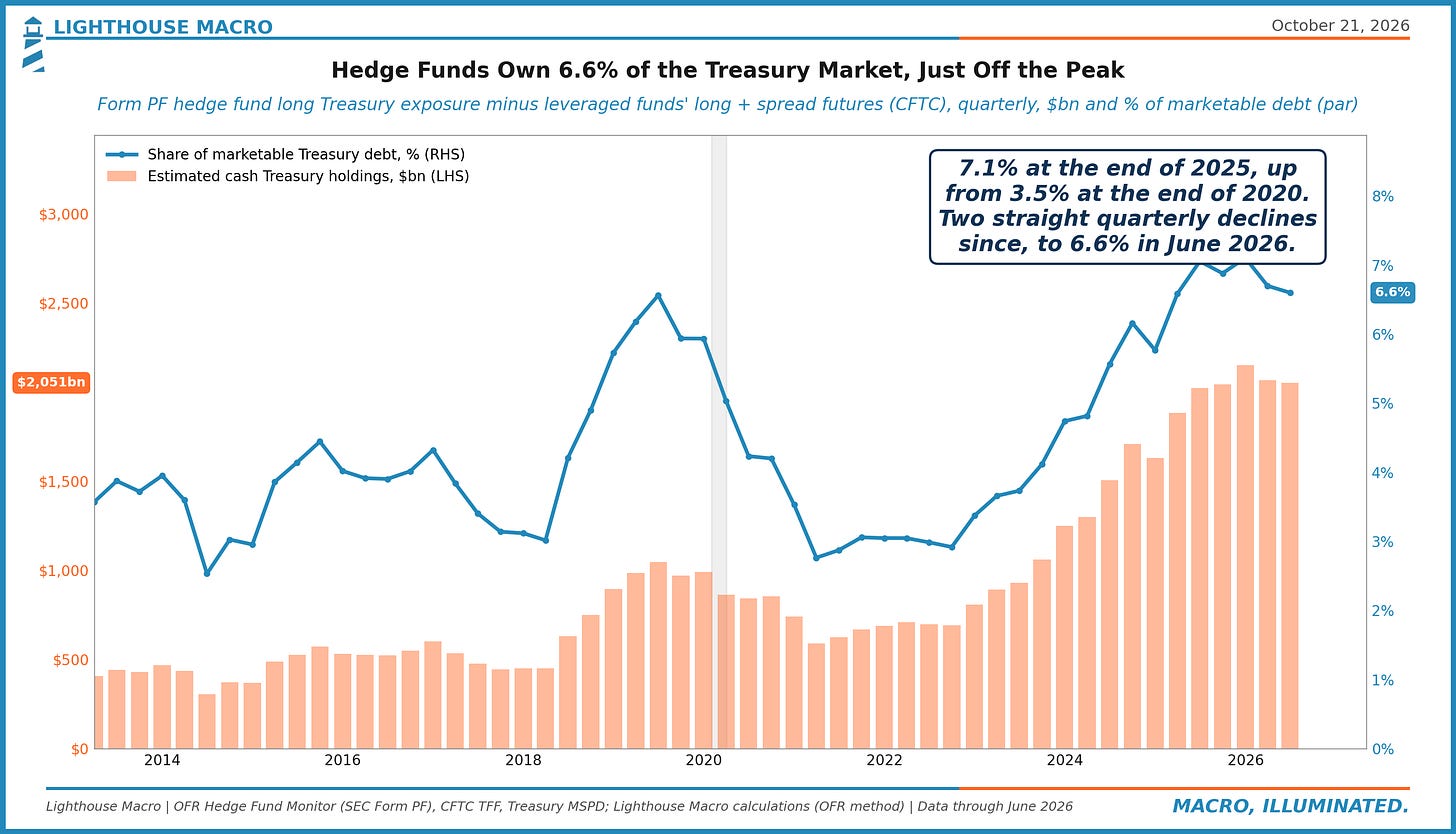
The chart above is our build of the Office of Financial Research's method, a bit above OFR's own count of $2 trillion at the end of 2025. The futures short is down 30% from its November 2024 peak. Over the same stretch the bonds went up, from $1,631bn at the end of 2024 to $2,051bn in June, off a $2,150bn high at the end of 2025. Whatever replaced the futures leg, the Treasuries didn't leave.
What It's Saying Now
Briefly, since this is the part that moves with the long end. The 30-year closed at 5.33% on October 23 and the 10-year at 5.00%, still far nearer the card than the 4.58% when the short peaked.
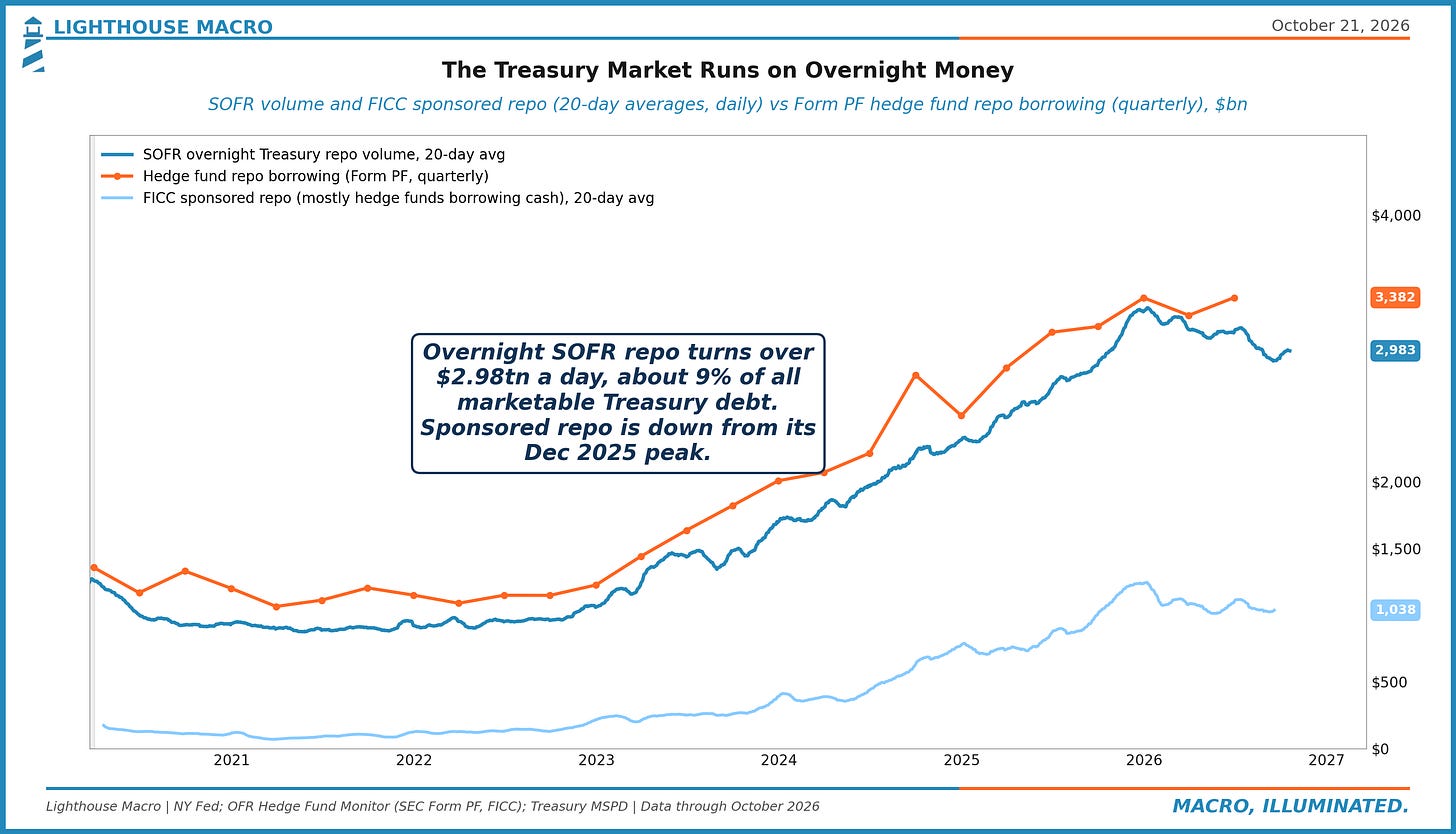
The funding side is three measures saying three things. The overnight Treasury repo market that sets SOFR has been turning over about $2,987bn a day on a 20-day average through October 23. Sponsored repo through FICC, the Treasury repo clearinghouse, was $1,085bn on September 18, down from $1,384bn on the last day of 2025. The authors use the delivery-versus-payment slice of it as a rough proxy for the cash leg and note it has "eased from [its] peaks"; OFR's series, which is what we chart, folds general collateral repo in with it. Hedge funds' total repo borrowing on the SEC's Form PF was a record $3,382bn at the end of June, though it counts all their repo and runs a quarter behind. The three only collide if you pretend they measure the same thing.
If you run a business, the piece of this nearest you is the long end. The cost of anything you finance for a decade or more is set in a market whose biggest buyers of duration are changing how they buy it. There's a smaller, stranger link too. If you borrowed from a private credit lender at a floating rate and swapped it to fixed, somebody received that fixed, and the Dallas Fed raises the possibility, on anecdotal evidence, that somebody is increasingly the asset manager who used to buy futures. In a small way, you're part of their fourth channel.
The last time the 30-year closed at 6% or higher was June 23, 2000. On October 7, 2026 it reached 5.67%.